Tag: Discipleship

  • Hosanna!

    Hosanna!

    Scripture reading: Mark 11:1-10

    The United Nations General Assembly recently voted to recognise the enslavement of Africans during the transatlantic slave trade as “the gravest crime against humanity.” The resolution, proposed by Ghana, also urged member states to consider issuing apologies and contributing to a reparations fund. Reparation is the act of making amends for a wrong by offering restitution, payment, or assistance to those who have been harmed.

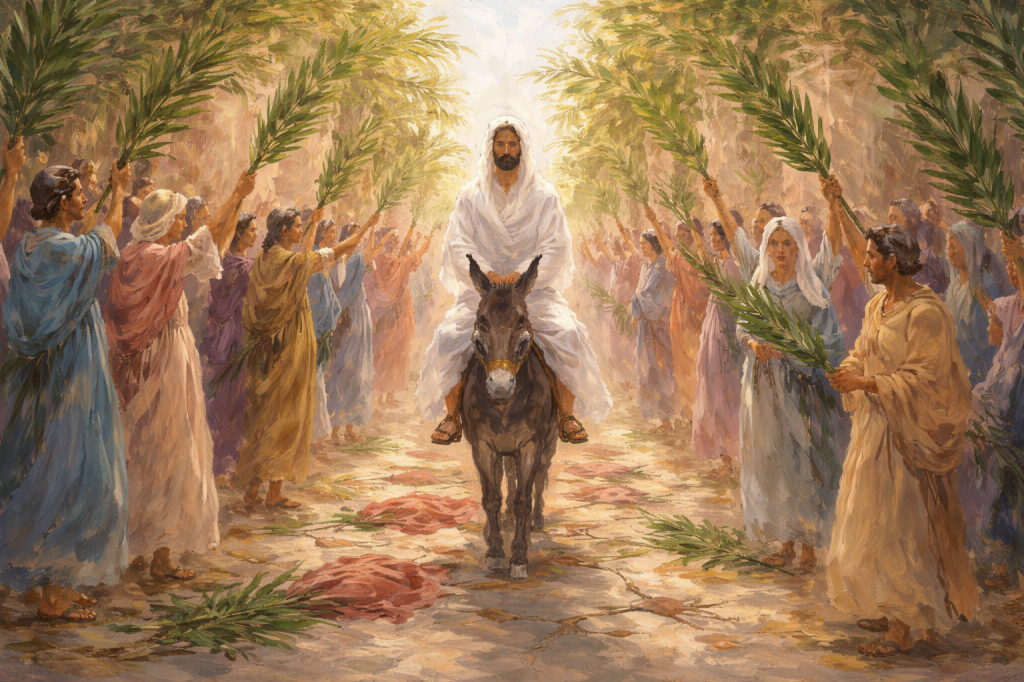
    Jesus’ final entry into Jerusalem marked the beginning of a far greater act of reparation, one that would culminate in the ultimate payment for all of humanity’s wrongs, even the gravest ones. As the crowds cried out, “Hosanna!” —  which literally means “Save us!”— they longed for a political deliverer, a conquering king who would overthrow Rome and restore their national glory. Unbeknownst to them, the true King had come, not to overthrow Rome, but to overthrow sin.

    Palm Sunday marks the beginning of His final week— a week in which He would fulfil His divine mission of liberating humanity from the bondage of sin. He rode into Jerusalem on a colt, quietly fulfilling prophecy—humble, yet purposeful. He came to bring eternal freedom, but the people were fixated on temporary relief. They saw the moment. He saw eternity.

    Are we so consumed by the troubles of today that we are losing sight of eternity?

    What began with loud praise on Sunday would end in a brutal cross on Friday. The same voices that shouted “Hosanna!” would soon cry, “Crucify Him!” The same crowd that celebrated Him would abandon Him. Triumph gave way to sacrifice; expectation collided with divine purpose.

    And then there is the colt.

    A colt that had to be loosed before it could be used.

    In much the same way, many of us are bound by fear, sin, doubt, and distraction, unable to step into God’s purposes. But when Christ takes the reins, everything changes. What is bound is loosed. What is ordinary becomes sacred. What is surrendered becomes purposeful.

    Just as He triumphantly entered Jerusalem, when we open our lives to Him, He comes not merely to visit, but to restore, to reign, and to make all things new. Hosanna, then, is not just a shout of praise; it is a surrendered prayer: “Lord, save us… Save us Your way.”

    Pause and Reflect

    1. What kind of salvation am I seeking?
    The crowd cried “Hosanna,” but their expectations were temporary.

    • Do I seek God only for immediate, visible breakthroughs?
    • Or am I open to the deeper, spiritual work He wants to do in me?
    • Am I aligned with God’s purpose, or just my expectations?

    2. What needs to be loosed in my life?
    The colt had to be released before it could be used.

    • What is holding me back—fear, sin, pride, distraction?
    • What am I still holding onto that God is asking me to surrender?
    • What must I let go of for God to fully use me?

    3. Have I truly allowed Jesus to reign?
    The people welcomed Him, but many did not accept His lordship.

    • Have I invited Jesus into every area of my life?
    • Do I follow Him only when it’s convenient, or even when it’s costly?
    • Is Jesus a guest in my life, or truly my King?

    Prayer

    Lord Jesus, I lay down my expectations and invite You to lead. Save me—not my way, but Yours. Loose every chain that holds me back— fear, sin, doubt, and distraction— and teach me to follow You in humility and trust. Reign in my heart, restore what is broken, and make my life a reflection of Your purpose.

    In Jesus’ name I pray, Amen.

    Thank you for joining us for today’s encouragement. If this message blessed you, kindly share it with someone who may also be encouraged by it.

    Until next time, stay blessed.

  • Immunity

    Immunity

    Scripture reading: John 8:31-36

    Immunity is the ability of the body to recognise, resist, and eliminate harmful organisms or substances such as bacteria, viruses, parasites, and toxins. In simple terms, immunity is the body’s defence system against disease. This immunity can be innate—the natural immunity one is born with—or acquired, that is, immunity that develops after exposure to a pathogen.

    Acquired immunity can be active or passive. Active immunity occurs when the body produces its own antibodies through natural infection or vaccination. An example is the immunity one gains after recovering from chickenpox. Passive immunity, on the other hand, is immunity derived from antibodies received from another source. An example is the administration of Rho(D) Immune Globulin to prevent rhesus isoimmunization, as we discussed in last week’s devotional, “Sensitisation.”

    The truth is that the Christian is not entirely immune from sin. Even after salvation, believers still struggle with sin. We will not be completely free from it until we die or until Jesus returns. Yet becoming a Christian results in a changed life (2 Corinthians 5:17). When a person accepts Jesus as Lord and Saviour, he becomes a new creation. He moves from a kingdom where, by virtue of his sinful nature, he could not help but sin, into a new domain where he is clothed with Christ. Christ becomes his righteousness. In that sense, Christ becomes his new innate immunity by virtue of the new birth.

    Instead of producing the works of the flesh (Galatians 5:19–21), the believer begins to display the fruit of the Spirit (Galatians 5:22–23), as the indwelling Holy Spirit increasingly takes control of his life. This transformation does not occur instantly, but it does occur progressively. The old nature begins to lose its dominance. The flesh begins to die.

    Along the way, the believer also develops something like acquired immunity—a growing resistance to sin. Through conscious striving, repentance, and sensitivity to the Spirit’s guidance, he learns to keep sinful acts at bay. If a person claims to believe yet shows no evidence of a changed life, it raises serious questions about the genuineness of his faith.

    And sometimes, the believer may still fall. But he does not remain in the dirt. That fall often strengthens his resolve to rise again and continue pressing forward. In that sense, each failure, met with repentance, builds a kind of active immunity against repeating the same sin.

    The difference between a sinning unbeliever and a sinning believer is this: one loves his sin, while the other hates it.

    The believer who stumbles regrets it, confesses it, and longs never to repeat it. He seeks God’s grace and power to avoid it in the future. He does not ask how much he can sin and still be considered a Christian. Rather, he asks how he can avoid even the appearance of sin.

    The believer may stumble, but he does not settle in sin. Grace lifts him, repentance cleanses him, and the Spirit strengthens him. Over time, the soul that walks with Christ becomes increasingly resistant to the very sins that once mastered it.

    Just as the body develops immunity to resist disease, the believer must develop a growing resistance to sin. The goal is not to see how close we can live to sin, but how far we can live from it. A healthy spiritual life is one that increasingly rejects what once infected it.

    To conclude, let us reflect on this question: If I truly belong to Christ, do I see evidence that my desires, attitudes, and actions are gradually being transformed?

    Let us pray. Heavenly Father, thank You for the new life we have in Christ. Help us to grow in our resistance to sin and to walk daily in the power of Your Spirit. When we stumble, grant us hearts that quickly repent and return to You. Shape our lives so that we increasingly love righteousness and hate sin. In Jesus’ name, Amen.

    Thank you for joining us for today’s encouragement. If this message blessed you, kindly share it with someone who may also be encouraged by it.

    Until next time, stay blessed.

  • Viral

    Viral

    Scripture reading: Matthew 28:16-20

    Viral infections are known to be highly contagious. Once an infection is established, it can spread through direct contact, through the air, on surfaces, via carriers, or even from mother to child. One infected person can transmit it to many, who in turn transmit it further. What begins with a single host can expand exponentially across communities, cities, and nations. The recent COVID-19 pandemic is a clear case in point. What started in one location quickly spread across the globe, affecting millions.

    In the digital world, “viral” content spreads in a similar way. On platforms like TikTok or YouTube, one person shares a video or post, others repost it, and networks multiply it rapidly. Algorithms amplify their reach, and soon it is everywhere.

    Virality, whether biological or digital, follows a simple pattern: contact leads to multiplication, and subsequently expansion.

    In Matthew 28:19–20, Jesus gave His disciples this charge: “Go therefore and make disciples of all nations…” It was, in essence, a command to make the Gospel spread to the ends of the earth. Not long afterwards, empowered by the Holy Spirit (Acts 1:8), the Gospel began to spread rapidly. By the time we read Acts of the Apostles 17:6, critics were saying: “These men who have turned the world upside down have come here also.” The message spread so widely that it unsettled the Roman world. Many believers paid for it with their lives. Yet they could not remain silent. The message was too good, and everyone needed to hear it.

    The Gospel literally means “good news.” It is the message of God’s love and redemption through Jesus Christ. The Gospel announces that: Humanity was separated from God because of sin (Romans 3:23), God provided a way back through Jesus Christ, who lived perfectly, died for our sins, and rose again (1 Corinthians 15:3–4), Whoever believes in Him receives forgiveness, new life, and eternal life (John 3:16; 2 Corinthians 5:17), and this new life transforms character, relationships, and purpose (Ezekiel 36:26; Galatians 5:22–23).

    The Gospel is not merely moral advice or a religious story. It is “the power of God for salvation” (Romans 1:16). It is the ultimate life-giving contagion because it strengthens, restores, and multiplies in ways nothing else can.

    If today a cure for HIV/AIDS were discovered, that news would spread instantly across the globe. The Gospel proclaims the cure for sin. It announces deliverance from eternal separation from God (John 5:24). Everybody needs to hear it. Every true Christian is called to share it.

    How to we Spread This Holy Contagion

    1. Abide in Christ

    Jesus revealed the foundation in Gospel of John 15:4–5:

    “Abide in me… Whoever abides in me and I in him, he it is that bears much fruit.”

    Abiding produces fruit. Fruit carries seed. Seed multiplies life.

    Spend time in prayer (1 Thessalonians 5:17), in Scripture (2 Timothy 3:16–17), and in worship. Let your relationship with Christ shape your every word and action.

    2. Live a Fruitful Life

    The fruit of the Spirit — love, joy, peace, patience, kindness, goodness, faithfulness, gentleness, and self-control — is listed in Galatians 5:22–23.

    Let others see Christ in your conduct before they hear Him in your words (Matthew 5:16). A transformed life is compelling evidence of a transforming Saviour.

    3. Share Your Testimony Naturally

    “You will be my witnesses” (Acts 1:8).

    Speak about what Christ has done in your life. Share your struggles, victories, and growth. A witness simply tells what they have seen and experienced.

    4. Engage Your Networks

    Viruses often spread from an epicenter. In the early church, that center was Jerusalem (Acts 1:8). Start with your immediate circle — family, friends, colleagues, church, and online communities — and allow the message to multiply relationally.

    5. Use Every Platform Faithfully

    No avenue is insignificant. Whether through social media, small groups, writing, music, or conversation, share Scripture and encouragement (Colossians 4:6).

    6. Pray for opportunities and Open Doors

    Paul asked believers to pray “that God may open to us a door for the word” (Colossians 4:3). Ask God to prepare hearts and to make your witness fruitful.

    7. Teach and Disciple

    The command was not merely to make converts, but disciples (Matthew 28:19–20). Guide others to grow. A disciple who bears fruit becomes a multiplier (2 Timothy 2:2).

    A Sobering Reminder

    Recently, reports indicated that a popular actor, Eric Dane, died from Amyotrophic lateral sclerosis. In his interview on Netflix, it was painfully evident how severely the disease had taken its toll on him.

    In Amyotrophic lateral sclerosis (ALS), motor neurons slowly degenerate and die. As they stop sending signals to the muscles, the body weakens, deteriorates, and eventually loses vital functions.

    Sin operates in a far deeper way. “The wages of sin is death” (Romans 6:23). Left untreated, it cripples and ultimately destroys.

    The Gospel proclaims the cure for sin, and it remains truly “good news” only if it reaches its hearers in time. The longer it is withheld, the more firmly sin entrenches itself. If you possessed the cure, would you keep it to yourself, or would you share it?

    Questions to Reflect On

    • If someone spent a week near me, what would they “catch”?
    • Am I abiding deeply enough for fruit to form?
    • Does my witness flow from transformation or obligation?
    • Am I intentionally using my networks to spread life?

    Let us pray

    Lord Jesus,
    Abide in me as I abide in You.
    Let Your life take root so deeply that fruit becomes inevitable.

    Make my love visible.
    Make my peace steady.
    Make my witness natural.
    Make my life a channel of Your transforming power.

    Help me share the Gospel through words, actions, and presence,
    so that Your life spreads, multiplies, and bears eternal fruit.

    Amen.

  • Vital Signs

    Vital Signs

    Scripture reading: Mark 11:12-14, Luke 13:6-9

    Have you ever visited a clinic where a healthcare professional checks your temperature, pulse, blood pressure, or respiratory rate? Ever wondered why? These measurements are called vital signs, basic indicators that reveal how well your body’s essential systems are functioning. Think of them as the body’s quick status check: the warning lights on a car’s dashboard, or even your bank balance, if you catch my drift.

    In today’s reading from Mark, we encounter Jesus performing a quick “status check” of His own, on a fig tree. He was hungry and saw the tree from a distance. It had leaves. That was promising.
    When a fig tree has leaves, fruit should follow. Jesus knew this. It was expected. The vital signs pointed to a healthy, fruitful tree. Yet when He approached the tree, He found nothing. No fruit. Only leaves. How disappointing!

    Luke records a similar moment in the parable of the barren fig tree. The owner of the vineyard, God, comes expecting fruit from His tree: us. He expects it. And rightly so. Considering the immense investment of His only begotten Son, Jesus, the keeper of the vineyard, who tends, nourishes, and intercedes for us, how could He expect anything less?

    The owner says to the keeper of the vineyard, “Look, for three years I have come seeking fruit on this fig tree and find none. Cut it down; why should it use up the ground?”

    But the vinedresser pleads, “Sir, let it alone this year also, until I dig around it and fertilize it. And if it bears fruit, well. But if not, after that you can cut it down.”

    The question presses itself upon us: Are we bearing fruit?

    Fruition is the natural outcome of a branch’s connection to the vine (John 15:4–5). Fruit does not come from striving, but from abiding. The presence, or absence, of fruit is a vital sign that reveals the health of our relationship with God. Are we bearing fruit?

    Fruit is what the world experiences when it encounters us. It is the visible result of the inward work of the Holy Spirit (Galatians 5:22–23): love, joy, peace, patience, kindness, goodness, faithfulness, gentleness, and self-control. Are we bearing fruit?

    Fruit is the quiet but irresistible light your good deeds give off, the savour of Christ your life exudes, causing others to glorify God (Matthew 5:16). Are we bearing fruit?

    Biologically, fruits exist to carry seeds to ensure continuation and multiplication, even under harsh conditions. Spiritually, fruit looks like witness and disciple-making: lives transformed and faith reproduced (Matthew 28:19–20). Are we bearing fruit?

    One remarkable thing about fig trees is that they advertise their fruit by producing leaves. Which leads to a sobering question: if we profess Christ, what evidence do we offer to support that claim?

    In today’s scripture, we find Jesus’ heart-warming plea when the owner of the vineyard asked for the unfruitful tree to be cut down: “Sir, let it alone this year … until I dig around it and fertilize it…”

    This is mercy. But it is mercy with an expectation. Jesus has allowed us the opportunity and mercy of the present to get things right: to abide closely, love Him more dearly and follow Him more nearly. Christ’s sacrifice must count for something!

    “That [we] may walk worthy of the Lord, fully pleasing Him, being fruitful in every good work and increasing in the knowledge of God” (Colossians 1:10).

    Let us pray

    Father,
    We come before You with open hearts and unguarded lives.
    You see us as we truly are, beyond appearances, beyond leaves and language.
    You search for fruit.

    Lord, we confess that there are seasons when we look alive,
    yet inwardly we have grown barren.
    We have mastered the form, but neglected the flow.
    We have worn the leaves, but withheld the fruit.

    Thank You for Your patience.
    Thank You for the mercy that digs around our roots,
    for the grace that fertilizes tired soil,
    for the Son who intercedes when judgment feels deserved.

    Teach us to abide in You,
    To remain close to You, the true Vine.
    Let Your Spirit work deeply within us,
    producing love where there was indifference,
    peace where there was restlessness,
    and obedience where there was resistance.

    Make our lives a blessing others can taste.
    Let our words, our actions, and our presence
    quietly point the world back to You.
    May our lives proclaim Your glory
    without needing to announce it.

    Lord, while there is still time,
    Do Your work in us.
    Prune what must be removed.
    Strengthen what is weak.
    And let us be found fruitful,
    fully pleasing to You.

    We ask this in the name of Jesus,
    the faithful Keeper of the vineyard.

    Amen.