
Author: On Rounds with Jesus

  • When we pray

    When we pray

    Scripture reading: Matthew 6:5-15, NKJV

    Strong relationships are built on robust communication. Many relationships falter because of communication breakdowns. Christianity, unlike organized religion, is a relationship— one that must be actively maintained through constant, heartfelt communication with God. Prayer is not optional for the Christian; it is essential. It is on this premise that Jesus taught His disciples to pray.

    Jesus emphasized that prayer must be sincere. It must not be draped in flowery language to impress onlookers or ‘manipulate’ God. Prayer is not for show; it is not an exhibit of piety. Eloquence and verbosity do not sway God—it is the heart that moves Him. Prayer must be intimate and precise, and grounded firmly in faith.

    When we pray, we must know who we are addressing: Our Father in Heaven. A Father who cares and loves us deeply. A Father who has our best interests at heart. A willing Father. A dependable Father. Our Father. The word “our” reminds us that we are not alone. We are not alone in our struggles. We are not alone in our journey. We have community, and we have a God who hears us. This understanding must shape our posture in prayer.

    “Hallowed be Your name. Your kingdom come. Your will be done on earth as it is in heaven.”  Prayer begins with God—not us. When we pray, our primary focus should be God’s glory—His Name, His Kingdom, His Will. We pray for God’s name to be honoured in our lives, our circles, and our world. We pray for the earth to be filled with the knowledge of the glory of the Lord, as the waters cover the sea. We pray for His Kingdom to be established on earth and for His will to prevail. We pray for the spread of the gospel, for the salvation of many searching for hope, for healing for the sick, and for liberation of the oppressed. Our prayers must first be directed toward God—and then they can reflect on our needs. Seek first His Kingdom…

    “Give us this day…” One of the cures for worry is daily dependence on God’s provision. In prayer, we entrust our needs to Him. We have a Father who knows us and knows our needs even before we voice them. A Father who gives good gifts to His children. A Father who forgives—and, as He forgives us, our default response to those around us must be one of ready forgiveness.

    When we pray, we must ask for the discipline to resist temptation, and the grace to be delivered from evil. We must pray for wisdom to navigate the inevitable “thirst traps” that plague today’s world, and for the laser-sharp focus to pursue righteousness. We must ask for the strength and endurance to run without growing weary, and the resilience to ultimately overcome.

    When we pray, we lose ourselves and become more and more like our Father in heaven.
    When we pray, we make room for God to reveal His glory more clearly in our lives.
    When we pray, we build the resilience to withstand the storms that life brings our way.
    So pray—because the fervent, constant prayer of the righteous is powerful and effective.

    Let us pray.

    Our Father in heaven,
    Hallowed be Your name.
    Your kingdom come.
    Your will be done
    On earth as it is in heaven.
    Give us this day our daily bread.
    And forgive us our debts,
    As we forgive our debtors.
    And do not lead us into temptation,
    But deliver us from the evil one.
    For Yours is the kingdom and the power and the glory forever.

    Amen.

    Reflection

    What is your prayer life like, and how can you improve it by incorporating the lessons from today’s message?

  • Cures for worry

    Cures for worry

    Scripture reading: Matthew 6:25-34, NKJV

    Worrying is dwelling on a problem, or a potential problem, usually one over which we have no control, and getting worked up about it. Humans, by default, worry. And when we do not curb this habit, worry can give rise to unnecessary anxieties that fuel unfounded fears. Fear, as we learnt last week, can lead to death. Today’s message teaches us to guard against this deadly pandemic we know as worry.

    First cure – Prioritize

    “. . . Do not worry about your life, what you will eat or what you will drink; nor about your body, what you will put on. Is not life more than food and the body more than clothing?” (verse 25)

    We live in a world today where the temporal seems to matter more than the eternal. It’s a materialistic world, where everyone seems to be chasing the fleeting and ignoring the lasting. If we peg our feelings on fickle things, our feelings will be fickle. Life matters more than food, and the body more than clothes. Prioritize the quality of your life—your health—over trendy, fleeting delicacies. Prioritize your well-being over fashion. Prioritize eternity over the temporal. Prioritize, strategize, plan—that’s your first cure. Don’t be moved by the general flow.

    Second cure – Trust in God’s grace.

    “Look at the birds of the air, for they neither sow nor reap nor gather into barns; yet your heavenly Father feeds them.” (verse 26)

    Sometimes we forget that the things which appear ‘natural’ are actually the Lord’s active doing. We are not owed breath or life ‘by default’; it is God’s grace that makes these possible. Everything depends on God. And that’s how we need to naturally trust Him to provide.

    This by no means suggests we should be lazy. Just as God has provided for the bird, the bird still needs to fly, hunt, and feed. As we trust in God’s provision, we must show responsibility by working hard.

    Third cure – Know your worth.

    “Look at the birds of the air… Are you not of more value than they?” (verse 26)

    Do you know your worth?

    “What then shall we say to these things? If God is for us, who can be against us? He who did not spare His own Son, but gave Him up for us all—how will He not also, along with Him, freely give us all things?”

    If God gave up His only begotten Son for your sake, will He not also provide everything else you need?

    Knowing your worth who you are is also a cure for unnecessary comparisons that can fuel anxiety.

    Fourth cure – Realize that worry is not productive.

    “Which of you by worrying can add one cubit to his stature?” (verse 27)

    Fifth cure – Seek first the Kingdom.

    “Seek first the kingdom of God and His righteousness, and all these things shall be added to you.” (verse 33)

    Seeking the kingdom means making evangelism and discipleship our primary endeavour. We must constantly pray for people to know Christ and take advantage of opportunities to witness to others. Seeking God’s righteousness means conquering sin and replacing it with righteous acts and attitudes. Jesus has promised that once we seek these, all other things will be added to us. Cash in.

    Sixth cure – Take it one day at a time.

    Therefore do not worry about tomorrow, for tomorrow will worry about its own things. Sufficient for the day is its own trouble. (verse 34)

    Everyday has its troubles—it’s a given. But amidst these troubles, God promises grace for the day. Just as the Israelites in the wilderness only received enough bread for each day, God often does the same with us. He gives grace for the step we are on, not the next step—only grace for the day. He does this so we can learn to lean on Him daily.

    Worry is a void created by a lack of faith. Lord, help our unbelief!

    Prayer

    Lord, help our unbelief.
    Where, in word or deed, we have denied Your wisdom by failing to see what You are doing…
    Where we have denied Your love by acting as though You do not care for us…
    Where we have denied Your power by thinking You are unable to deliver us…

    Unburden our worries
    Engulf us with Your love
    Let us know You are with us.

    Reflection

    What worries distract you from reaping the full benefits of God’s promises?

  • The storm is over!

    The storm is over!

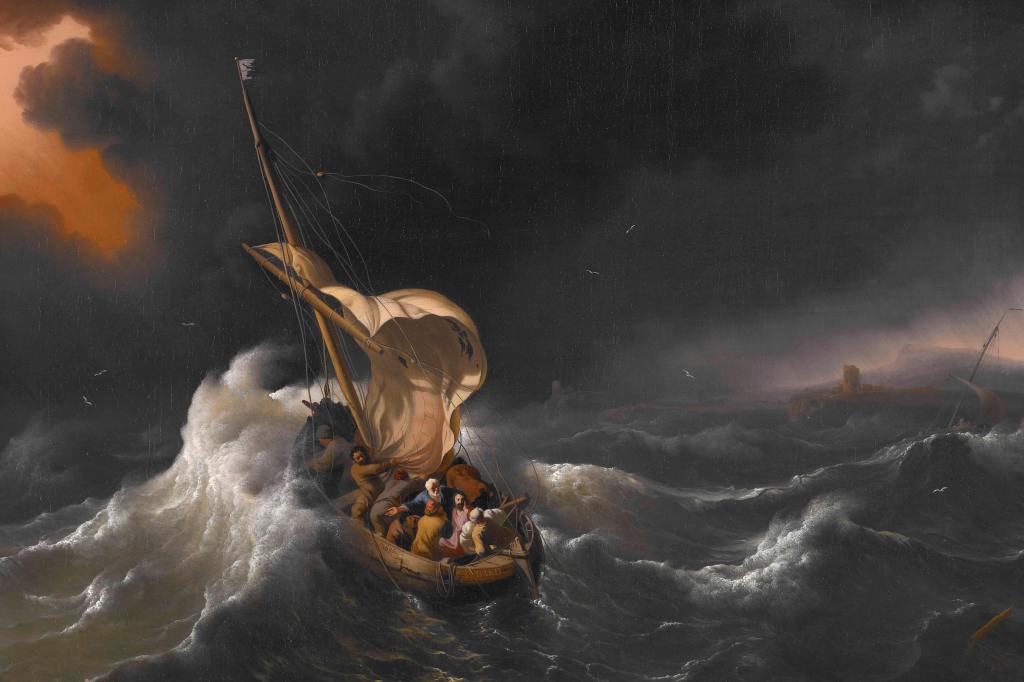
    Scripture reading: Mark 4:35–41

    My first real experience of ‘turbulence’ was probably when I encountered an eclamptic patient for the first time. She was a young woman, about seven months into her first pregnancy, who had been wheeled into the emergency room a few minutes after having a fit and losing consciousness. She went on to have a series of violent seizures — several bouts of vehement, untamable tremors involving her entire body — that had to be aborted with waves and waves of intravenous anticonvulsants. It was like a storm.

    In Mark 4:35-41, we witness yet another storm. On the evening of a day when Jesus had been teaching His disciples powerful truths about the Kingdom, He decided to put them through a practical session on faith. He said to them, “Let us cross over to the other side,” and the disciples obliged, unaware of what lay ahead. Among them were seasoned fishermen who were no strangers to the Sea of Galilee and its occasional turbulence.

    On their way across, “a huge storm came up. Waves poured into the boat, threatening to sink it” (Mark 4:37, MSG). Storms come to prepare us for ‘the other side’. God allows certain storms to shape and strengthen us for what’s next. In life, we will encounter many challenges. These challenges are meant to stretch us — to test and strengthen our capacity to overcome — and in the process, make us better. Without fire, there’s no refining. Faith must be tested, and our resolve must not waver when boisterous waves pour into our boat, threatening to sink it, because Jesus is in the stern.

    “Jesus was in the stern, head on a pillow, sleeping! They roused him, saying, ‘Teacher, is it nothing to you that we’re going down?” (Mark 4:38, MSG). They were afraid. But three things should have put them at ease:

    1. Jesus had assured them they were going to the other side (verse 35).
    2. He was with them (verse 36).
    3. He was peacefully asleep as though there was no imminent danger (verse 38) — because, as we’ll soon see, there wasn’t.

    Instead, they fixed their eyes on the waves. Faith perishes where fear thrives. And fear thrives when we focus on our turbulent circumstances instead of fastening our faith to the Rock that cannot move — Jesus. They failed the test (verse 40).

    Jesus steps in. “…He told the wind to pipe down and said to the sea, ‘Quiet! Settle down!’ The wind ran out of breath; the sea became smooth as glass.”Mark 4:39, MSG

    One of the tenets of managing obstetric emergencies like eclampsia is to call for help. At times, experience alone is not enough. Occasionally, our faith may falter. But when we call on Jesus, He will intervene. When He speaks, the billowing waves settle like glass, and not a whisper is heard from the wind. When He speaks, the storm is over!

    Let’s Pray

    Lord, quieten these storms —
    Waves of doubt threatening to flood my heart.
    Let me know You are with me.

    Lord, calm the turbulence —
    Winds of fear threatening to shake my soul.
    Let me know You are with me.

    As the boisterous sea rages around me,
    May Your unfailing Word anchor me.
    In the midst of the storm — “Peace, be still!”

    Reflections

    1. What are some examples of storms that tend to test your faith in God? What are you most afraid of?
    2. To deal with fear, you need faith. Faith comes by imbibing God’s Word.
    3. How can you keep yourself grounded in God’s Word?
    4. The essence of tests is growth. Beyond having a personal relationship with Him, God is invested in your journey — in you crossing to the other side.
    5. You are not alone, even when it feels like it. God is near.
    6. Call on Him in times of trouble — and He will answer (Psalm 50:15).
  • Refresh

    Refresh

    Scripture reading: John 2:1-11, NKJV

    John begins his account of Jesus’ first recorded miracle with “on the third day”, almost as though he is cueing us into some kind of resurrection story. Or was he?

    Jesus, His mother, and His new disciples had been invited to a wedding feast in Cana. The next thing we read from the account is that what was meant to be the refreshment at the ceremony—the wine—runs out. This is not a good thing. Jewish weddings were a very big deal back then and could last for days. The wine was not to run out, as it symbolised joy and abundance. This was a highly embarrassing social faux pas, one that could become the subject of ridicule for years to come. Imagine the utter disgrace. The party was almost dead.

    We don’t know exactly how close Mary was to the bridal party, but she notices very early that “there was no wine,” and that timely intervention was needed. She turns to Jesus. In medical terms, you could say Mary “called a code.” This often refers to initiating a rapid response to a medical emergency, like a cardiac or respiratory arrest. Urgent cardiopulmonary resuscitation was required to save what seemed to be the dying moments of this party.

    Mary recognised the need to act promptly. But more importantly, she recognised that Jesus was there at the wedding feast— and that only He could bring whatever was left of it back to life.

    Mary says to the servants, “Whatever He tells you, do it.” And they do.

    Jesus asks the servants to fill some empty jars nearby with water. Once they are filled, He instructs them to draw some of it out and take it to the master of ceremonies. The emcee takes a sip of what is soon to be the choicest wine at the feast and cannot stop singing praises to his hosts. If only he knew that just moments earlier, it had been plain, bland water drawn from pots meant for ceremonial cleansing.

    Jesus can turn your plain, bland life into a joyous spring of fine wine, so delightful that everyone who tastes it cannot get enough. But you need to give Him the chance. You need to let Him in. You need to let Him fill you.

    Worn out, tired, waning? The refresh button you need is Jesus. Jesus is the new wine—you haven’t tasted better.

    Oh, taste and see that the LORD is good; Blessed is the man who trusts in Him!

    — Psalm 34:8, NKJV

    Let’s Pray

    Pray…
    For a refilling—
    Where your love for God may be dwindling

    A rekindling—
    Where your joy may be waning

    Where the gloom of disgrace may be lurking,
    Where the emptiness of worthlessness may be surging,
    That the Lord will fill you with His new wine—
    With His divine Spirit that makes all things new.


    May the Lord make you a refreshing testimony to His glory.
    Amen.

    Reflections

    1. Who do you share your problems with? Mary shared hers with Jesus because she knew who He was and what He could do.
    2. Jesus is the only answer— never mind the question.
    3. The key lies in obeying His instructions: “Whatever He tells you, do it.”
    4. Jesus can use whatever is available— there was no wine, but there was water. What do you need? Look at what you have.
    5. When you put your trust in Jesus, it never goes to waste.
    6. “Why have you saved the best for last?” (John 2:10) What Jesus gives is built to last. What they had was water for external cleansing. He gave them wine to satisfy within. The stone jars were empty— He filled them up. What they were facing was imminent death and shame… He gave them life and joy. Tired and heavy-laden? Jesus offers you rest.